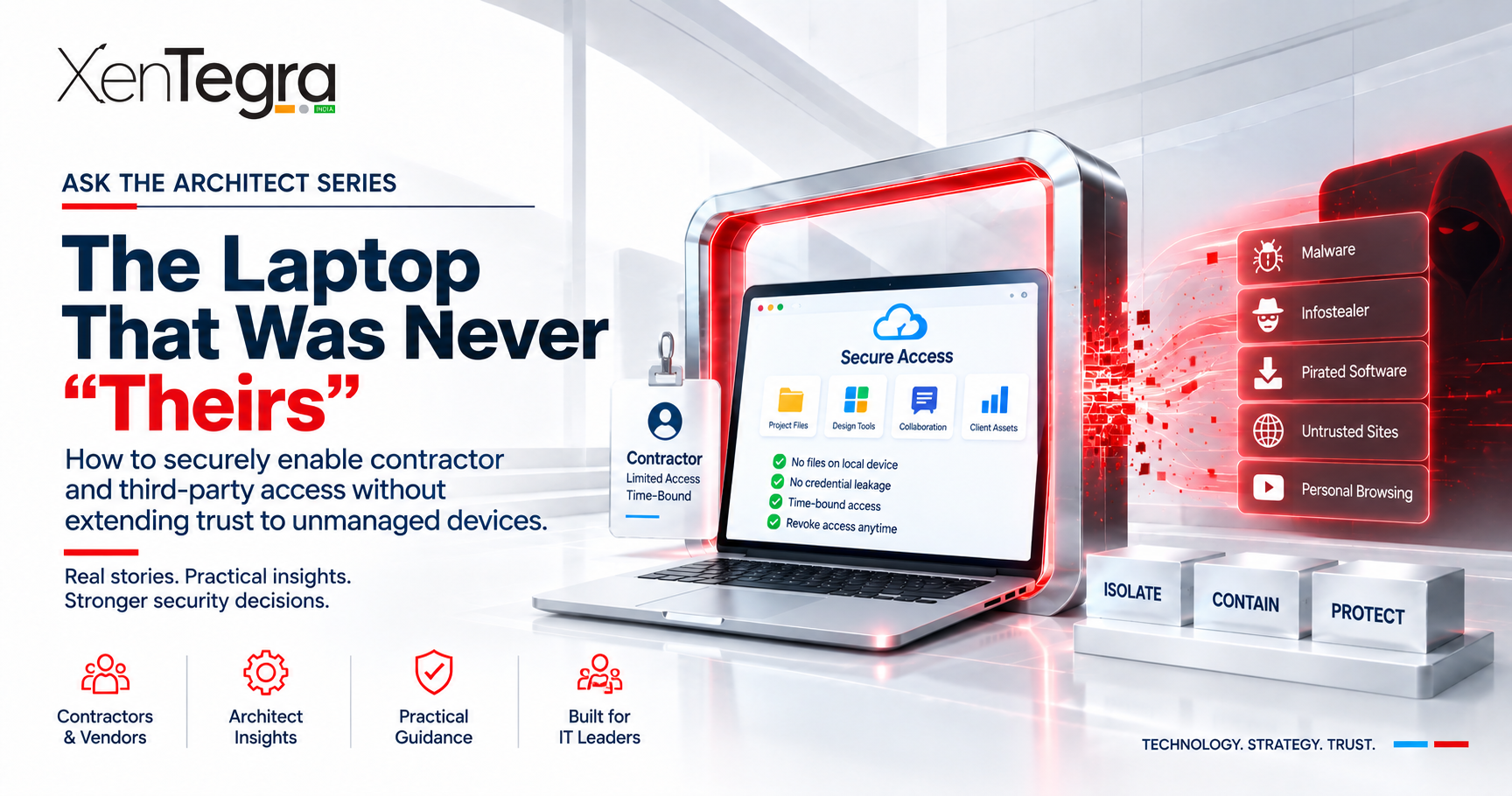
Your contractor may be trusted. Their laptop may not be.
Ananya runs a 60-person design and consulting studio.
Business is growing, and so is her extended workforce. Freelance designers. Remote specialists. Contractors brought in for short projects.
For one client engagement, she hired a freelance UI designer for a two-week sprint.
He needed access to two things:
The client's project management platform and a shared drive containing confidential, unreleased brand assets.
So Ananya did what thousands of businesses do every day.
She created guest access, sent him the credentials, and got on with the project.
The freelancer did excellent work. He finished early. The engagement ended.
Three weeks later, the client called.
Their unreleased product designs had appeared in the hands of a competitor's marketing agency.
The obvious suspect was the freelancer.
Except he hadn't stolen anything.
The breach happened somewhere nobody was looking.
The freelancer worked from his personal laptop.
It was also the laptop he used for personal browsing, freeware, entertainment, family use—and software downloaded from sources nobody in Ananya's organization could control.
Unknown to him, the machine was already compromised by an infostealer.
For months, malware had been quietly collecting information from the device: browser sessions, saved credentials, autofill data and other accessible information.
The client's environment was simply another valuable account accessible from an already-compromised endpoint.
Nobody had to hack Ananya's company.
Nobody had to hack her client.
A laptop neither organization owned, managed nor secured became the pathway to information they were responsible for protecting.
And that changes the architectural question.
“But it was only temporary contractor access.”
I hear versions of this constantly.
Agencies working with freelancers.
Hospitals bringing in visiting specialists.
Law firms collaborating with outside counsel.
Manufacturers providing access to third-party auditors.
Consultancies bringing specialists onto customer engagements.
The access may only last two weeks.
The risk can last considerably longer.
The instinctive response is usually to strengthen the NDA, require MFA, tighten password policies or deploy endpoint management.
Those controls have value.
But they don't solve the fundamental architectural problem:
You cannot fully enforce your endpoint security posture on a device you don't own or manage.
You can require MFA.
You can't necessarily determine what else is running on that contractor's laptop.
You can't guarantee its security tools are healthy.
You can't know every application that has been installed.
And you may have little control over what happens to corporate information once it reaches that endpoint.
It isn't your endpoint to manage. But once it accesses your environment, it becomes part of your risk.
The BYOD Problem Isn't Really About BYOD
It's about trust.
Traditional enterprise architecture was designed around an assumption:
We trust the endpoint before we give it access.
That works reasonably well when the organization owns the laptop, manages its configuration, controls software installation, deploys security tools and continuously evaluates its posture.
But today's workforce doesn't stop at the corporate device.
Contractors. Vendors. Partners. Freelancers. Consultants. Auditors. Temporary employees.
The modern access model increasingly includes devices IT has never touched.
So perhaps the better question isn't:
“How do we secure their laptop?”
It's:
“Why does their laptop need to become a trusted participant in the first place?”
Why the Traditional Answers Can Fall Short
VPN + Credentials
A VPN encrypts connectivity.
That's important.
But encryption doesn't magically make the endpoint trustworthy.
If the endpoint itself is compromised, providing network connectivity may simply create another pathway toward corporate resources.
You're securing the tunnel without necessarily securing what's entering it.
Full VDI
Virtual desktops can provide strong isolation and control and remain the right architecture for many use cases.
But deploying a complete desktop environment may be excessive when the requirement is:
“Give this contractor access to two applications for fourteen days.”
For short-term or narrowly scoped access, organizations often want something lighter and faster without surrendering security controls.
That's where the architecture gets interesting.
The Architect's Approach: Don't Extend Trust to the Device
Instead of trying to make an unmanaged endpoint behave like a corporate endpoint, separate the application session from the endpoint itself.
One approach is browser isolation.
The contractor still opens a browser.
They still interact with the application.
From their perspective, the experience can remain familiar.
But the sensitive browsing session and application interaction are isolated from the unmanaged endpoint.
Depending on the implementation and policies, organizations can restrict capabilities such as downloads, uploads, clipboard operations, printing and other forms of data movement.
The principle is simple:
Give the user access to what they need without giving their endpoint the same level of trust.
Think of it like reviewing sensitive documents inside a controlled room.
You can read them.
You can work with them.
But you don't automatically get to walk out carrying the originals.
What Would Have Changed for Ananya?
Had the contractor's access been delivered through an appropriately configured isolated access environment, the security architecture could have been designed around the assumption that his laptop was already untrusted.
That is the important distinction.
The organization could:
- Isolate sensitive application sessions from the contractor's unmanaged endpoint.
- Restrict downloads and data movement based on policy.
- Reduce exposure of credentials and session information on the unmanaged device.
- Time-box access around the actual engagement.
- Revoke access immediately when the project ends.
And most importantly:
The security model no longer depends on knowing whether the contractor's laptop is clean.
Assume the endpoint is compromised.
Then design the access architecture accordingly.
Zero Trust Should Include the Endpoint You Don't Own
Zero Trust discussions often focus on identity.
Who are you?
Then MFA.
Can you prove it?
Then authorization.
What are you allowed to access?
But third-party access introduces another question:
What device are you accessing it from—and why should I trust it?
The person may be completely trustworthy.
Their endpoint may not be.
Those are two different security decisions.
And as organizations increasingly depend on external talent, treating them as the same decision creates a growing blind spot.
The Awareness Gap
Most organizations still think about cybersecurity primarily in terms of attackers:
“Who is trying to get into our environment?”
But some of today's most difficult risks don't begin with someone attacking your firewall.
They begin with someone you legitimately invited in.
- A contractor.
- A supplier.
- A consultant.
- A partner.
- A guest account.
- A temporary employee.
- The identity is legitimate.
- The access is authorized.
The endpoint is the unknown.
That's why third-party access architecture needs to evolve from:
“We trust you, so we'll trust your device.”
to:
“We trust your identity for this specific purpose. We don't need to trust your device.”
That is a much stronger foundation for modern access security.
Ask the Architect
If your organization regularly gives freelancers, contractors, vendors or partners access to internal applications, ask your security team one question:
“What happens if their laptop is already compromised before they connect to us?”
If the answer depends primarily on trusting their endpoint security, there may be an architectural gap worth examining.
At XenTegra, our role isn't simply to recommend another security product.
It's to help customers examine how applications, identities, endpoints and data interact, then design an access architecture appropriate to the risk.
Because sometimes the best way to secure a device you don't control…
is to stop requiring that device to be trusted in the first place.
Ask the Architect | XenTegra
Technology. Strategy. Trust.
#AskTheArchitect #BrowserIsolation #ZeroTrust #BYOD #ThirdPartyAccess #CyberSecurity #EnterpriseSecurity #SecureAccess #DigitalWorkspace #XenTegra